Loading
Services
Small production runs, without a mould
Twenty, eighty, three hundred. Quantities where tooling costs more than the whole order is worth, produced from an approved design with consistent dimensions and finishing across the batch.
The problem this solves
Injection moulding is the right answer at volume and the wrong one below it: the tool has to be paid for before the first part exists, and at a few hundred units that cost dominates everything. Producing the same design additively has no tooling to amortise, so a run of forty costs forty parts — and the design can still change between batches.
A product before it is a product
A first commercial run while demand is still being tested, without committing to a tool that fixes the design.
Sets and fitted systems
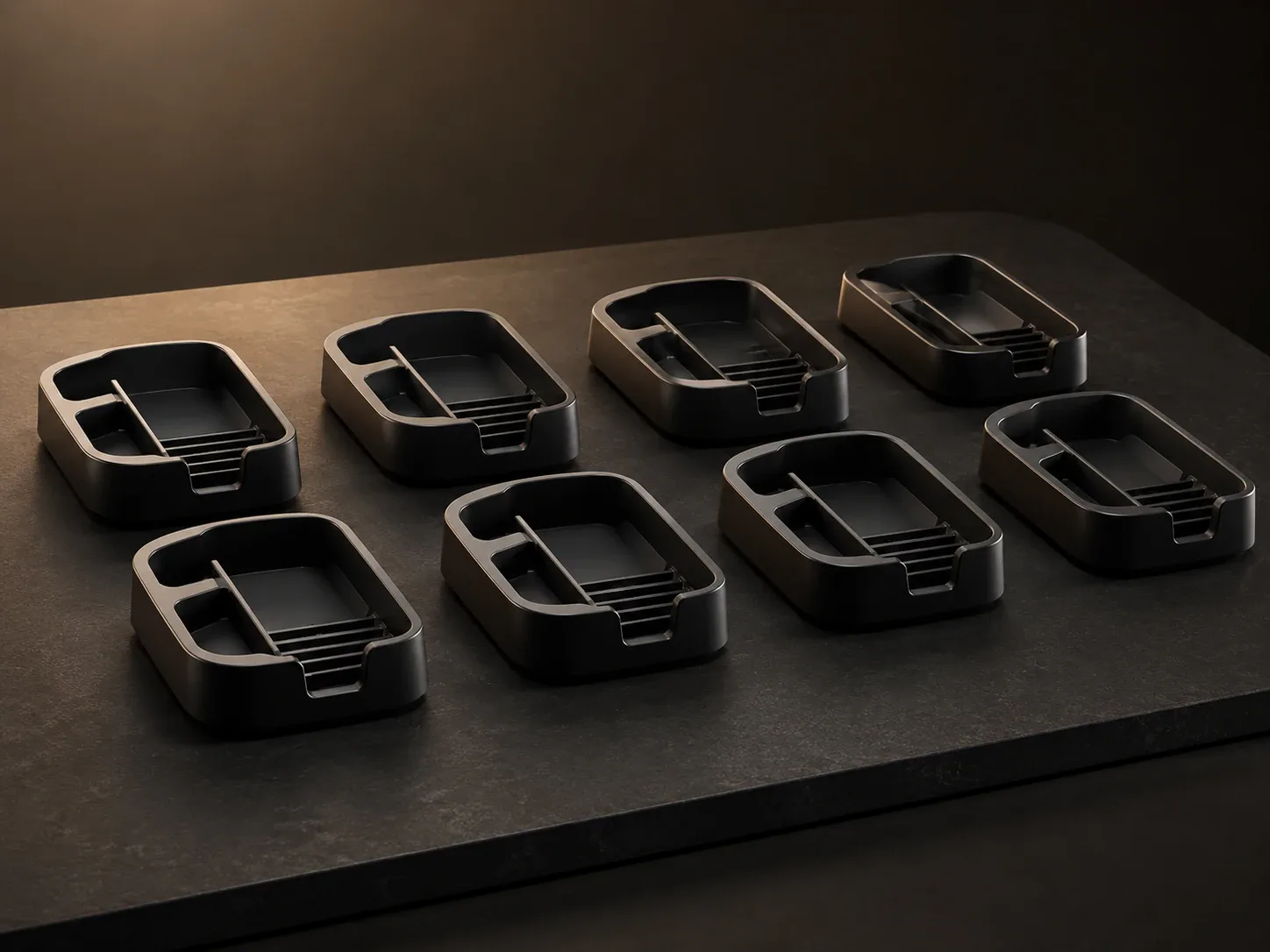
Trays, inserts and organisers made to fit a specific drawer, case or workspace, in the quantity that workspace repeats.
Event and campaign quantities
A defined number of pieces for a launch, a season or a set of locations, where the run has a real end rather than a forecast.
What the studio does
- Prepare the design for repetition
- A part made once and a part made three hundred times are not the same problem. Orientation, supports and finishing are settled so that the last one matches the first.
- Hold the batch consistent
- Dimensions and finishing are checked across the run, not on the first piece only, and every piece is inspected before it is packed.
- Say when we are the wrong answer
- Past a certain quantity moulding is the better commercial route, and we will tell you where that line falls for your part even though it means turning the work down.
What to send us
A run needs a design that is settled. If yours is not settled yet, that is a prototyping conversation first — and a cheaper one to have before three hundred of something exist.
- An approved design, or the design work as part of the project
- The quantity, and whether it repeats
- Any dimension that is functional rather than aesthetic
- The date it has to exist by, if there is one
How small, and how large
From one
There is no minimum. A single piece and a batch of five are ordinary work here, and the same care goes into both.
Up to a few hundred
Repeatable runs from an approved design, produced in batches with consistent dimensions and finishing. Above that range we will be straight with you about where moulding becomes the cheaper answer.
Materials and finish
- Premium polymer
- Designed and produced by the studio in polymer selected for the use, not for appearance alone.
- Matte, low-sheen surface
- Finished to avoid a glossy plastic look and to keep fingerprints from reading.
- Purchased components
- Any glass, stainless steel, candle or fastener in this design is a bought-in part integrated into it — the studio does not produce metal.
Parts designed and produced by the studio are premium polymer. Any metal or glass elements are purchased components integrated into the design.
How it usually goes
- 01
Tell us the quantity and the design
Both matter to the answer. The same part at ten and at four hundred is produced differently.
- 02
Sample first
One piece from the run, approved by you, before the rest are made. The sample is what the batch is then measured against.
- 03
Produce in batches
Made, finished and inspected in batches, with the sample as the reference throughout.
- 04
Deliver, and keep the file
The approved model is kept, so a repeat run months later starts from the same design rather than from a new one.
Where we work
Everything is produced in Italy. Delivery is not included in the price: it is quoted with your confirmation, for mainland Italy as for the islands and the rest of Europe, before you approve anything.
Where to go next
- Capabilities3D modelling, rapid prototyping, CAD-to-physical production, file preparation and custom parts in premium polymer, produced in Italy.
- For businessPresentation systems, operational solutions, proprietary product development, prototypes and limited production runs, developed around the outcome you need.
- CollectionBrowse ISPIRENZA designs by category and use. Every piece can be adapted in size, colour, finish and personalisation.
Tell us the quantity
The design, the number and the date. That is enough for a real answer rather than a range.
What happens next
We review what you sent
Your description, photos, files and voice note are read by a person, not sorted by a form.
We ask if something is missing
If a dimension, a use or a deadline changes the answer, we come back with a short question.
You receive a clear reply
Feasibility, the route we recommend, and what we still need in order to price the work.
Production starts after you approve
Only once the design, the details and the terms are agreed does anything get made.
We normally reply within Within 24 hours.
Before you send anything
The first assessment is free
We look at what you send and tell you honestly whether it can be made, and how.
Treated confidentially
Files, drawings and project details stay between us. Nothing is published without your agreement.
No commitment
Sharing an idea does not oblige you to anything. You can stop at any point.
Paid production only after approval
Nothing is produced or invoiced until you have approved the route, the details and the price.
Your project
Start with the thing itself. Rough is fine — describe it, say it out loud, or show us a photo.
A few lines is enough. Describe the problem if the piece is not clear yet.
0 of 1200
Voice note(optional)
Often the fastest way to explain an idea. Stored privately and never published.
Recording stops automatically after 3 minutes.
Photos, sketches or files(optional)
Drag files here, or
Images, PDFs and 3D files. Up to 4 files, 4 MB each.
When it has to exist
A real date changes what we can promise, so it is worth answering honestly.
How many?
How to reply
We normally reply within Within 24 hours.
Parts we design and produce are made in polymer. Glass, metal, candles, electronics and hardware can be built into a piece as purchased components.
Questions people ask first
What is the minimum quantity?
There is not one. One piece is a normal order here — the run pricing simply reflects that setting up for forty is not forty times setting up for one.
Will every piece be identical?
They are produced from one model with one set of settings and inspected against an approved sample, so they match to the tolerance the process holds. Where a dimension has to be exact we measure it on the parts rather than assume it.
Can the design change between runs?
Yes, and that is the real advantage over a mould. There is no tool to re-cut, so a revision between batches costs design time rather than tooling.
When should I be moulding instead?
When the volume is high enough that the tool pays for itself, which depends on the part far more than on a rule of thumb. Tell us the quantity and the geometry and we will tell you which side of that line you are on.