Loading
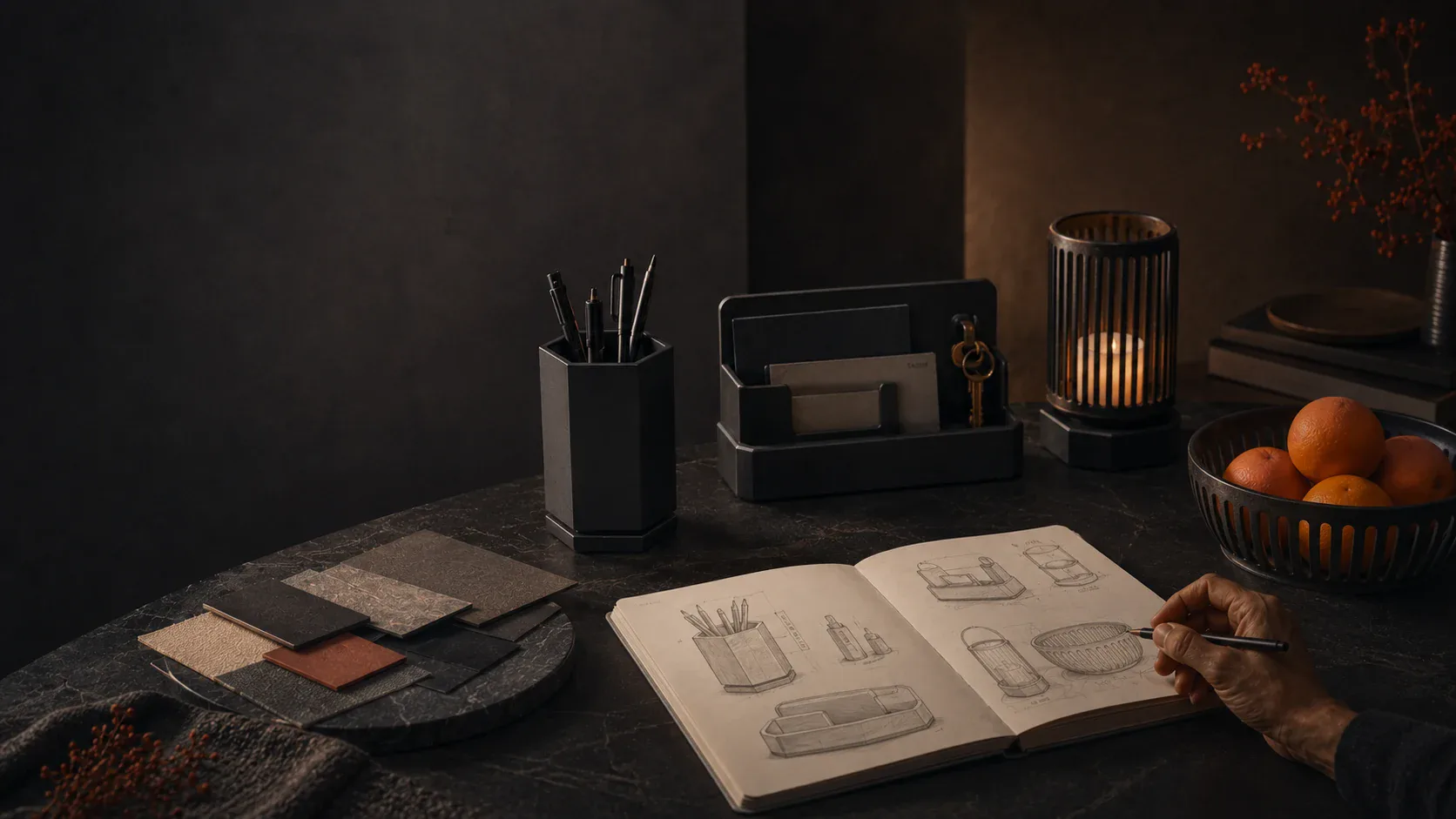
Custom design
You do not need a finished idea.
Send a sketch, a photo, a voice note or simply explain the problem. We will help turn what you have into something we can design, test and make.
What can you send us?
Any of these is a good starting point. One is enough.
Even a rough one on paper. It shows us what you are picturing.
Start with your ideaHow we help
The same five moves, adjusted to how far along your idea already is.
Clarify
We ask the few questions that actually change the design, and agree what success looks like.
Design
We develop the form, the fit and the details, and show you where the decisions are.
Test
We check the parts that carry risk — dimensions, strength, assembly, how it feels in the hand.
Produce
We make it in premium polymer, integrating any purchased components the design needs.
Inspect
We check the finished piece closely before it is packed and sent.
The kinds of problem people bring us
Not case studies — just a fair picture of the requests that arrive.
- 01
It exists, but not in the right size
A part, a holder or a fitting that is almost standard, except for the one dimension that matters to you.
- 02
It should exist, but does not
A specific piece for a specific habit, space or piece of equipment that nobody sells.
- 03
It broke and cannot be replaced
A discontinued component, a missing bracket, a fitting from something otherwise still good.
- 04
It has to mean something
A piece made around a person, a date or a story, where a bought piece would be the wrong answer.
- 05
It needs to work in a space
Something shaped around a specific wall, shelf, vehicle, counter or workflow.
- 06
It needs to feel considered
A piece that has to present something valuable properly — and look deliberate doing it.
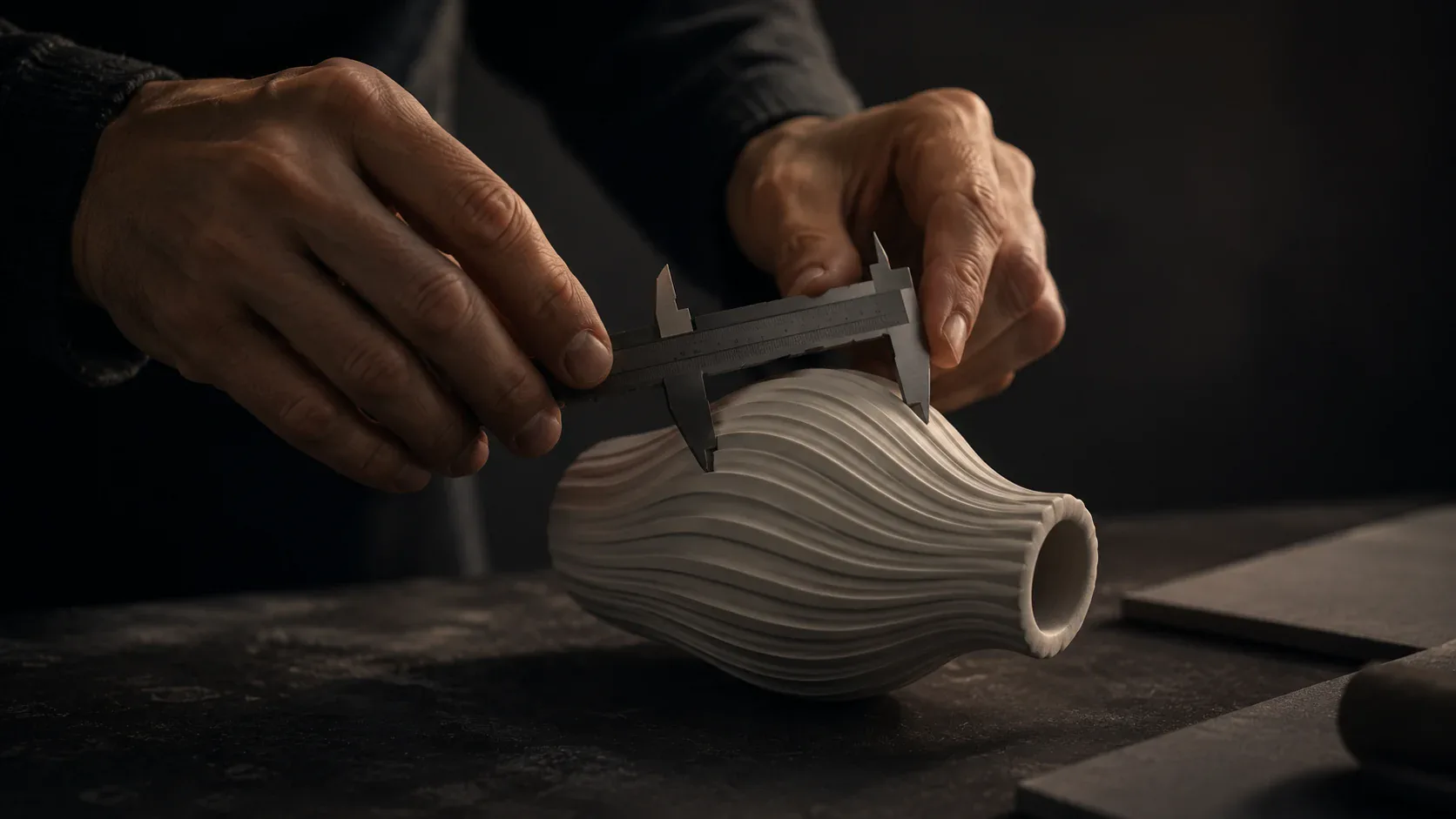
What affects feasibility and cost
These are the variables we look at first. Knowing one or two of them already helps.
- Size
- Larger pieces can be designed as assemblies, which changes the work involved.
- Complexity
- Geometry, moving parts and tolerances affect both design and production time.
- Material
- Different polymers behave differently for strength, texture, heat and outdoor use.
- Quantity
- One considered piece and a run of fifty are different problems to solve.
- Purchased components
- Glass, stainless-steel bowls, candles, electronics or fasteners can be integrated into the design.
- Finishing
- Surface treatment and hand finishing change both the result and the time.
- Deadline
- A firm date is workable if we know it early. Tell us the real one.
Tell us what you have in mind
A few lines, a photo or a voice note is enough to start.
What happens next
We review what you sent
Your description, photos, files and voice note are read by a person, not sorted by a form.
We ask if something is missing
If a dimension, a use or a deadline changes the answer, we come back with a short question.
You receive a clear reply
Feasibility, the route we recommend, and what we still need in order to price the work.
Production starts after you approve
Only once the design, the details and the terms are agreed does anything get made.
We normally reply within Within 24 hours.
Before you send anything
The first assessment is free
We look at what you send and tell you honestly whether it can be made, and how.
Treated confidentially
Files, drawings and project details stay between us. Nothing is published without your agreement.
No commitment
Sharing an idea does not oblige you to anything. You can stop at any point.
Paid production only after approval
Nothing is produced or invoiced until you have approved the route, the details and the price.
Your project
Start with the thing itself. Rough is fine — describe it, say it out loud, or show us a photo.
A few lines is enough. Describe the problem if the piece is not clear yet.
0 of 1200
Voice note(optional)
Often the fastest way to explain an idea. Stored privately and never published.
Recording stops automatically after 3 minutes.
Photos, sketches or files(optional)
Drag files here, or
Images, PDFs and 3D files. Up to 4 files, 4 MB each.
When it has to exist
A real date changes what we can promise, so it is worth answering honestly.
How many?
How to reply
We normally reply within Within 24 hours.
Parts we design and produce are made in polymer. Glass, metal, candles, electronics and hardware can be built into a piece as purchased components.
Common questions
What if my idea turns out not to be possible?
We tell you plainly, explain why, and where we can we propose a route that would work instead.
Do I need to know dimensions?
No. Approximate sizes, or a photo of the space or piece it must fit, are enough for a first assessment. Where a dimension turns out to matter, we will ask for that one specifically.
Do you charge for the design work?
Design work is quoted before it starts, as a fixed figure you approve — so you always know what you are agreeing to and there is never an open-ended hourly bill.
Will I see it before it is made?
Yes. You approve the design before anything is produced, and for pieces where form or fit carries risk we make a physical test piece first. Nothing goes into production on a description alone.
What if I do not like the result?
That is what the approval stages are for: the design is agreed before production, and revisions belong to that stage rather than after delivery. If a finished piece does not match what was approved, we remake it.
How long does it take?
Usually a few weeks from first message to finished piece, and most of that is design and your decisions rather than production. We give you a realistic date with the quotation, not an optimistic one.
Who owns the design?
What you bring stays yours. For pieces we develop for you, the commercial terms are agreed in writing before production begins.
Can you copy a piece I already own?
We can design something that does the same job, and we can reproduce a part of your own that has broken or been discontinued. We do not copy a design that belongs to someone else.
How big can a piece be?
Larger than most people expect: beyond a certain size a piece is engineered as an assembly with designed joints rather than made in a single part. Tell us the size you need and we will tell you how it would be built.
What are the pieces made from?
Parts we design and produce are made in polymer, selected for the use — strength, heat, texture or outdoor exposure all point to different choices. Glass, metal, candles, electronics and hardware are integrated as purchased components where a design calls for them.